Monday, April 8, 2013

Walking in Their Footsteps

The best way to capture the past is to step back into it -- visiting the places you are writing about. Last week Fran and I toured Monticello, the mountaintop home of Thomas Jefferson.  There is no better way to get into a person's head than to walk the red Piedmont soil and marvel at the blue rolling hills off in the distance. Now I know why he called it his "sea view."

But stepping back in time also takes a healthy dose of imagination, too. Mulberry row, where slaves lived and worked, is empty now. I have to imagine the lane busy with boys making nails, and the air  thick with smoke from the forge and the cook house. Instead of the two white women driving a four-wheeler from tree to tree in the orchard, I have to envision perhaps two black men carrying a ladder and saws to trim the branches.

The past is not black and white, either. Old photos make everyone look somber and give the impression that history was fuzzy and dull. But people wore shades of red and blue, laughed and danced.  One of the more startling things I noticed at Monticello was the neon yellow dining room. Not what I would have expected had I not known how much he appreciated light and air.

Hustled through the house with other tourists it was hard to really see everything, but then again, it gave me a more accurate portrayal of a house filled with children, servants, and family.  And when I return, I can dig deeper, look closer, and reveal even more.

Sunday, February 24, 2013

Writing is Glorious

Saturday night I saw Glorious! a hilarious play by Peter Quilter at the O'Connell & Company theater. Based on a true story, Glorious! is the life of Florence Foster Jenkins the worst singer in the world (check her out on Youtube). Florence, born in 1868, was the tone deaf daughter of a wealthy banker who forbade her from taking music lessons. She so loved opera that she eloped just to get away from her domineering father. Many years later she inherited her parents fortune and began a singing career. Still tone deaf and rhythmically challenged Florence performed her first recital at the age of 44.

Of course the play features her most bizarre quirks like she interviewed anyone who wanted to purchase a ticket, and created her own costumes favoring wings, tinsel and tiaras. After a taxi crash Florence discovered that she could hit higher notes, and sent the cab driver a box of Cuban cigars to thank him for increasing her range.

Although ridiculed with bad reviews and called 'First Lady of the Sliding Scale,' she had a cult following that included Cole Porter, Talula Bankhead, and Enrico Caruso.

Her peak came in 1944, when at age 76, the Diva of Din played Carnegie Hall - to a standing room only crowd.  Some in the audience jeered, some laughed, but most admired her remarkable zest for life, her courage, and her singular passion for music.

At one point in the play, Florence, played by actress Mary Kate O'Connell (who portrayed Florence's joy and jarring arias brilliantly) said,  "People may say I can't sing. But no one can ever say I didn't sing."

And that line, which might have been her mantra, reminded me how important it is to be unwavering in the pursuit of one's passions. As a writer you are constantly getting knocked down with written rejections -- and if you're like me, you actually keep them so they continue to taunt you every time you open up a file drawer!  It is easy for your passion to waver each time you're faced with the choice to sleep in or get up and write (will anyone care?), or when you start a new story (is it worth the effort?), read aloud in a critique group (will they like it?), type up a cover letter (it is right?), stuff a manuscript in an envelop or attach it to an email (is it ready?).

Be courageous and take a cue from Florence. Be selective of your audience. Don't send a manuscript to just any editor. Check out their blogs and interviews online, read the books they've published. Find out what they like, what they want, so you'll have fewer boos and more bravos.

Dress up your prose -- not with tinsel and tiaras, but with the best writing you can create-- vigorous verbs, dynamic details, and kick ass characters.

And when someone helps you raise your game with a bit of advice, a research lead, or a personal editorial note, show your appreciation. Build your fan base. Start now to fill Carnegie Hall.

Despite all the obstacles that stand in your way (most of which are in your head), make sure that when the literary-equivalent-of-the-fat-lady sings, no one can say you didn't write.


Monday, February 18, 2013

Farmer George in the Classroom

I may be behind the times, but I have added lesson ideas for Farmer George Plants a Nation to my website just in time for President's Day.

I am not a teacher, so I'm not fluent in lesson-plan-ease, but I do love to think up ways to use Farmer George as a jumping off point for teaching about seeds and soil, or discussing how agriculture was such an important element in creating a free nation. In this confusing time of Common Core and changing standards I hope it helps to have an author's perspective on where the information came from, how they write, and how their work fits into the larger picture.  I think Farmer George can be used in social studies or science class, and I'm hoping that any teacher who uses Farmer George will let me know what they did and how it went.

Please add your voice to the discussion of how nonfiction books can be used in the classroom.

I'll be adding lesson plans for For The Birds next.


Tuesday, February 12, 2013

Hooray For Clichés!

Not too long ago I was sitting in the audience listening to a distinguished writer talk about her craft when she segued into “What Not to Do!”  Then I saw her pick up one of my books.

My mind filled with a numbing buzz like anesthesia for surgery where your soul will be yanked out through your left eyeball. I can’t remember what don’t’s she referred to, but all the while she held my book. Then she opened it and said, “Unless you do it this way.” Ah, a reprieve. Or a backhanded compliment?  I still couldn’t focus. The horror of being so close to the Don’t list left my brain limp.

You have to know the rules, before you can break them. That’s what writers say. And maybe I fall into that category, or at least cling to the outside rim, because I’ve noticed that I’ve done it again.  Another common piece of advice is to avoid clichés.  And yet, one of the literary devices that I employed in For the Birds: the life of Roger Tory Peterson, included several clichés –
            He had eagle eyes.
            Like an owl he worked at night …
           He rose with the Robins
           It was time to make a nest of his own
           Determined as a woodpecker after a bug

I did add a few of my own:  
           He looked as thin and gawky as a fledgling egret
           As focused as a heron after a fish, he perched on the edge of his seat.

But I had a reason. I wanted to create the image of Roger as a Bird, so the reader understood how strongly Roger loved and responded to them. Using phrases like, “he roosted with …” and  “he migrated…” helped to reinforce this.

The use of common phrases and images can serve a purpose if you use them consciously and don’t overdo it.  Seven comparisons sprinkled throughout a 48 page book with 3,000 words seemed to do the trick. 

Will I break more rules in the future?  I’m sure someone will point it out to me.

Tuesday, January 29, 2013

Ag in the Classroom - Advocates for Children's Books


Have you ever dreamed of having a group of people who would support and promote your books? Even go so far as purchase an entire first printing?  Well, you can – if you write a book that accurately portrays farming or ranching.  I discovered this when my book Farmer George Plants a Nation earned awards from several state Farm Bureaus, and then again when I attended the Writing About Agriculture Workshop at the HighlightsFoundation this past weekend.

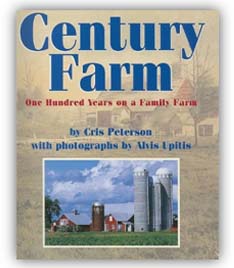
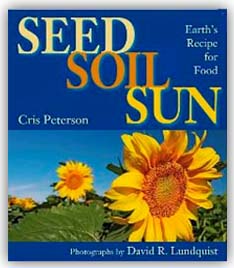
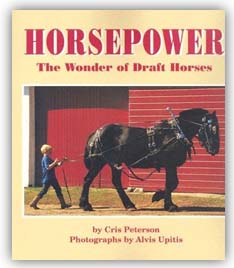
Cris Peterson, dairy farmer and author of ten award-winning books about “the wonder of where food comes from” spoke with passion about the negative stereotypes that surround farming (think 'Green Acres') – “We’re the last great prejudice,” she says.  And she’s out to squelch those stereotypes with picture books like Century Farm, Seed Soil Sun, and Horse Power, the wonder of the Draft Horse. “It’s all about the wonder,” Cris says. She wants to create that “Wow, I didn’t know that!” reaction from her readers, so they feel connected to what they eat, wear, and use everyday.  

Ask the next child you see where their food comes from and they’ll probably say, “The grocery store.”  Campbell’s Soup conducted a survey and discovered that 54% of the people they asked thought soup came from a factory. It's cooked and canned there, but what about those ingredients?  The business of Agriculture – the growers (large and small), processors, distributors, researchers, and everyone involved wants kids and adults to know where food comes from and how it gets to their table.  It’s a pressing need in this high-tech digital world where the amount of farmable land is shrinking and the population keeps growing.

I confessed my farm-faux-pas-near-miss in Farmer George when I wrote ‘pushed the plow’. Fortunately, the gaff was caught before printing and we changed it to “guide the plow.”  It may seem like a silly thing to someone who has never tilled a field, but it’s serious business for those who have.  They’re tired of picture books that show farmers in overalls milking a cow by hand, or pigs wallowing in the mud. That was then, but high-tech dairies with rotating carousels, and clean pigs are now.

Leading the cheering section for great Ag books is Kevin Daugherty the Education Director at Illinois Agriculture in the Classroom.  He spoke with such enthusiasm about how he and his staff actively seek out books that portray Ag in a positive light, and when he finds one, he purchases it to give to teachers throughout the state, along with lesson plans, activities and so much more.  And it’s not just Illinois. Every state is eager for books that connect children to their food and fiber. The goal is to help educators teach writing, reading, science, history and math through agriculture.

So, wondering what to write about? Think about agriculture and all of its possibilities. But -- Do your research whether it’s fiction or nonfiction, so you too, can have Kevin and all the folks like him support and promote your exciting, enlightening, and ACCURATE book about Agriculture.

Just a few great Ag books to check out:
       Picture Books:
                Apples to Oregon by Deborah Hopkinson
                Extra Cheese, Please! By Cris Peterson
                Fantastic Farm Machines by Cris Peterson
                Harvest Year by Cris Peterson
                The Scrambled States of America by Laurie Keller
                A Handful of Dirt by Raymond Bial

       Novels:
                A Season of Gifts by Richard Peck
                Little Joe by Sandra Neil Wallace
                The Beef Princess of Practical County by Michelle Houts
                Return to Sender by Julia Alvarez
                Just Your Average Princess by Kristina Springer

Monday, January 14, 2013

A Nod to Susan Kuklin's Blog post on Ethics in Nonfiction.

You might be interested in reading Susan Kuklin's blog post at INK about Ethics in Nonfiction.  It summarizes a panel that Susan sat on with Meghan McCarthy, Deborah Heiligman, and Sue Macy at the New York Public Library. I wish I had been there. 
http://inkrethink.blogspot.com/2013/01/ethics-in-nonfiction-for-kids.html.

All I can add is -- ditto.


Sunday, January 6, 2013

Left-brained thoughts on Writing

Several months ago I had a critique with an editor who read the first ten pages of a mid-grade novel I had been working on for several years.  He could tell from my writing that I wasn't a beginner, but there was something about my writing that stopped him from loving it, even though he liked the concept. We talked a bit more and when I confessed that I was primarily a nonfiction writer, he said, "Ah, that explains it," and advised me to go right when my brain told me to go left.  My writing was too stiff, he said. I need to be freer, get out of my comfort zone, go wild.  

I had nearly forgotten about that critique until I went to a workshop given by Andrea Page a fellow member of the Rochester Area Children's Writers and Illustrators.  Andrea was presenting "A Writing Workshop for the Right Brain."  Normally, this is the kind of program I would flee from because I've always believed that if you're going to write, then write. You don't need creative exercises.   But I went, partly because I didn't have choir, which normally occupies my Thursday evenings, and partly because I have to lead a workshop of my own in a few months and was curious how to handle writing assignments within a class setting.  

I'm so glad I did.  Thanks Andrea. Because I realized that the reason  I have disliked free writing and seemingly nonsensical exercises is that I am more left-brained than I'd like to believe.  I prefer to write for a reason. I prefer to be more organized, which surprises me since I am the least organized nonfiction writer I know (just visit my office).  I suspect that most nonfiction writers are more left-brained than right-brained.  What do you think?

And if this is so, that is probably why I have more trouble writing fiction than my nonfiction. So, the big question is: can I ditch my dislike of free-writing and incorporate it into my daily routine (which doesn't exist) in an attempt to pull myself away from the gravitational pull of my left brain and fling myself toward my right hemisphere?  I will try.  I would love to someday zip back and forth across my corpus callosum (the part that connects the two halves, Sibby) and really go wild with my writing.

It might take a while. I'm not very disciplined. But stay tuned to see what happens.